MUSE DHC partner Bois Énergie Renouvelable highlights the importance of dialogue in supporting the expansion of DHC networks in France, thereby contributing to ...
Mobilising communities to build district heating and cooling networks for a cleaner and more energy-independent Europe
Sofia, a single mother living in a top-floor flat, and Klaus, one of five family members living in a detached house, live in two different European countries, but they share the same problem: their energy bills are too high. Heating in winter and cooling in summer is becoming increasingly expensive as temperatures often reach extreme peaks. On top of that, both still rely on gas heaters-polluting, costly, and unreliable due to geopolitical tensions.
Since their cities introduced district heating and cooling networks, Sofia and Klaus no longer fear their bills. These networks connect their homes and neighbourhoods to shared systems powered by clean energy.
District heating and cooling (DHC) is a shared system that distributes heat and cold through underground pipes to multiple buildings, using local, renewable, and waste energy sources. Thanks to DHC, Sofia and Klaus now breathe cleaner air, save money, and feel part of the sustainable transition that will make Europe the first climate-neutral continent by 2050.
AN EU TEAM COMPOSED OF SUSTAINABILITY EXPERTS
MUSE DHC – community-led actions for Efficient District Heating & Cooling – is an EU-funded project that aims to accelerate the decarbonisation of European cities through the creation of efficient district heating and cooling (DHC) networks.
The project focuses on community-based models, integrating participatory governance, cooperative ownership structures, and advanced digital planning tools. Through the implementation of 9 pilot projects across Europe, MUSE DHC will propose scalable and replicable solutions for the decarbonisation of the heating and cooling sector in different contexts.
The project activities will support the development of DHC networks that will bring social, economic, and environmental benefits to communities, including lower energy costs, improved air quality, and increased citizen empowerment. MUSE’s goal is to demonstrate that by placing citizens at the center of the energy transition, it is possible to create more sustainable, equitable, and resilient local energy systems based on the use of renewable energy and waste heat recovery.


MUSE DHC aims to foster the diffusion of new efficient community-led District Heating & Cooling (DHC) systems, ensuring exploitation of renewable energy and maximizing socio-economic and environmental benefits for local communities and territories.
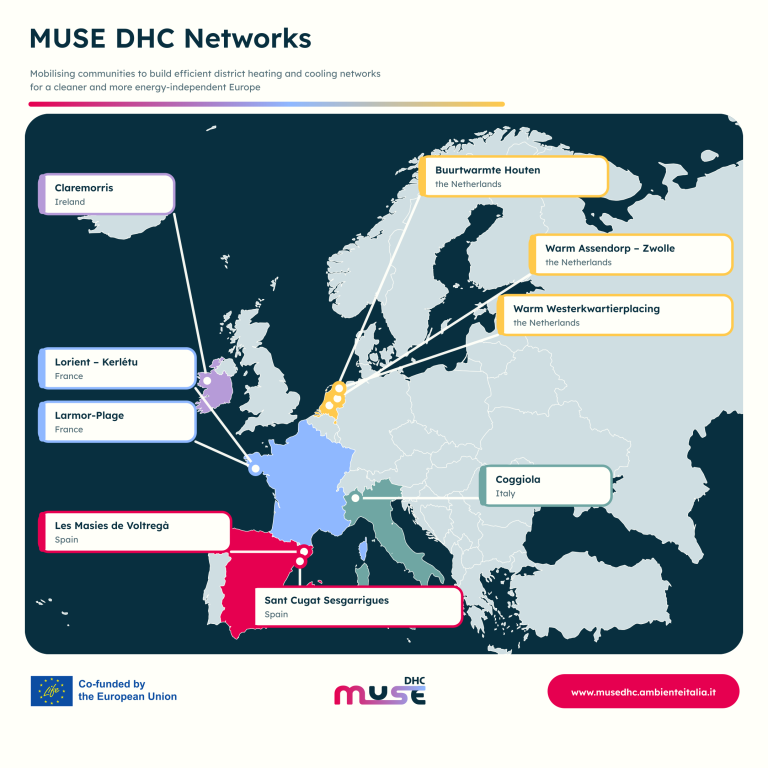
9 networks – or case studies – will be established in different European countries: France, Ireland, Italy, the Netherlands and Spain. The methodologies, tools, and strategies tested and improved during the project will be replicated by 9 additional networks during the second phase of MUSE DHC.
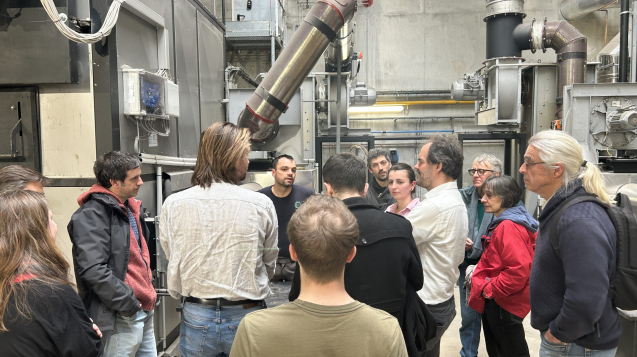
MUSE DHC partner Bois Énergie Renouvelable highlights the importance of dialogue in supporting the expansion of DHC networks in France, thereby contributing to ...
What is district heating and cooling? How is it related to the achievement of climate neutrality? And how can ordinary people play a role in all this? The E ...