
MUSE DHC contributed to the event “The Leaf: Communities driving the shift to fossil-free heating and cooling“
Heating and cooling account for more than half of Europe’s energy consumption. Yet despite its central role in the clean energy transition, the sector often remains trapped in technical discussions about boilers, efficiency rates and infrastructure upgrades.
On 29 April, at the Energy Cities Annual Forum in Guimarães, The Leaf: Communities driving the shift to fossil-free heating and cooling challenged this perspective. What if the future of heating and cooling depended as much on governance, participation and local ownership as on technology itself?
Bringing together municipalities, researchers and practitioners from across Europe, the discussion highlighted an emerging reality: the heat transition will not succeed without citizens and communities actively shaping it, as MUSE DHC proves.
Heating and cooling is also a social challenge
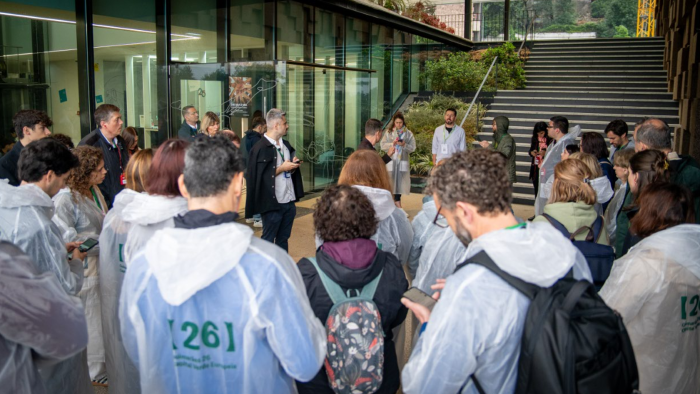
The day started with a concrete example: a visit to Gymnastic Training Center of Guimarães – GUIMAGYM, the city’s public sports facility. The building combines energy efficiency, renewable energy production and nature-based solutions into one integrated system. A 2,000 m² cork façade provides thermal and acoustic insulation, while 1,300 m² of solar panels and a geothermal network cover heating and cooling needs. Rainwater is also reused for sanitary purposes and HVAC cooling systems.
The inspiring visit was followed by the policy discussion during which Energy Cities presented the broader European context and its EU Tracker on local heating and cooling planning, according to which many Member States still lack clear frameworks, methodologies and support structures for municipalities. Cooling planning, in particular, remains largely neglected.
“Heating and cooling is still treated as a technical efficiency issue — not as a governance, social and territorial challenge” – participants overwhelmingly agreed. During the fishbowl discussions, recurring barriers emerged, such as fragmented responsibilities, lack of public awareness, insufficient coordination between stakeholders, financing difficulties and weak policy support for citizen-led initiatives. At the same time, many saw community-led approaches as one of the most promising pathways for accelerating the transition while increasing resilience and social acceptance.
Beyond solar panels: energy communities are also about heat
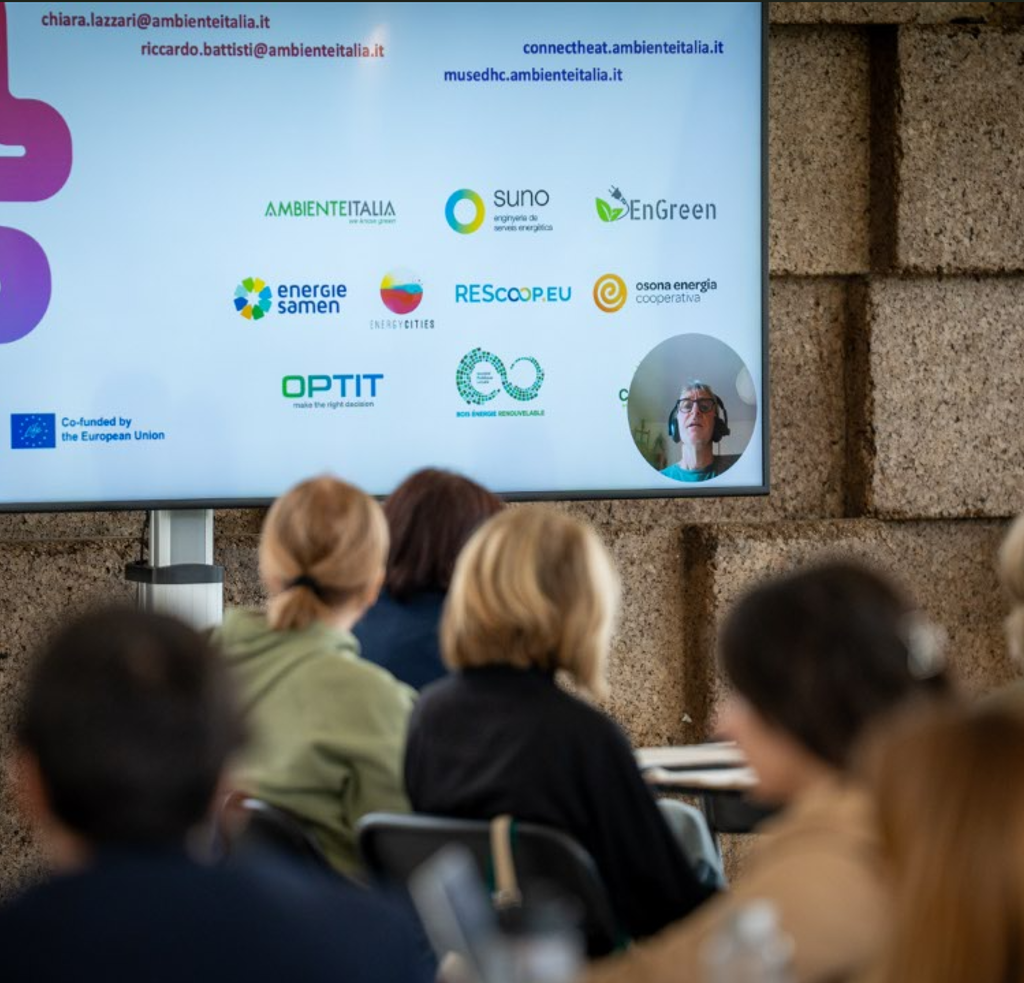
What’s your first thought when you hear “energy communities”? Most people think about electricity and rooftop solar panels. Heating and cooling, despite representing the largest share of energy demand, remain largely absent from policy discussions and public narratives. Lessons from the EU-funded projects MUSE DHC and Connect Heat inspired participants. Riccardo Battisti from Ambiente Italia, coordinator of MUSE DHC, explained that there is a gap in Europe’s energy debate and that is reflected in legislation itself. Existing European frameworks on energy communities rarely address heating and cooling explicitly, creating uncertainty for local actors trying to develop collective heat projects.
Yet examples already exist across Europe. The Connect Heat project identified several key policy priorities to unlock the sector: clearer legal recognition of heating and cooling communities, support for heat sharing models, incentives for “heat prosumers”, risk reduction mechanisms for district heating investments and stronger financial participation tools such as crowdfunding and collective ownership schemes.
Riccardo also stressed the importance of connecting community initiatives with formal planning processes. Local heating and cooling plans — now required under Article 25 of the Energy Efficiency Directive for many municipalities — could become powerful tools for integrating citizen-led projects into long-term territorial strategies. The new MUSE DHC project will work with several local authorities to test solutions.
The challenge, however, remains practical: “Energy communities are also about heat.”
Dijon shows how district heating can decarbonise at scale
Decarbonising is feasible! Nathanaël Leblanc, from Dijon Métropole, proved, through the example of the RESPONSE project, that large-scale transformation is possible. The results are significant: 75% lower CO₂ emissions and an 80% reduction in fossil gas consumption in the pilot neighbourhoods. The project combines waste heat recovery, biomethane, heat storage and smart energy management systems.
What made the Dijon example particularly relevant to the workshop discussions was its systemic dimension. The district heating network evolved through long-term territorial planning, linking public infrastructure, housing providers, waste management facilities and energy systems into one coordinated approach.
For many participants, it illustrated that scaling up clean heating solutions requires both infrastructure and governance capacity.
Cities are central actors of the heat transition
What role do municipalities play? Through the ESCALATE project, Antonia Kranz (IREES) showed how cities are increasingly expected to coordinate local heating and cooling planning under the revised Energy Efficiency Directive.
Yet many local authorities still lack the staff, tools and financial capacity needed to implement these new responsibilities. At the same time, energy communities can help fill part of this gap by mobilising local investment, increasing participation and supporting implementation on the ground.
“Community-led heating and cooling will never deliver at scale unless municipalities integrate it into formal planning, public policies and regulated energy systems” – If Europe wants to accelerate the heat transition, citizen-led approaches must become part of mainstream local energy planning.
The future of the transition lies in citizen-led approaches
The discussions in Guimarães made one thing clear: decarbonising heating and cooling is not simply a technological challenge. It is also a democratic one.
Whether through geothermal public buildings, district heating systems or citizen-led heat networks, the transition requires cooperation between municipalities, utilities, citizens and local organisations – community-led heating and cooling initiatives are the future of the clean transition.