
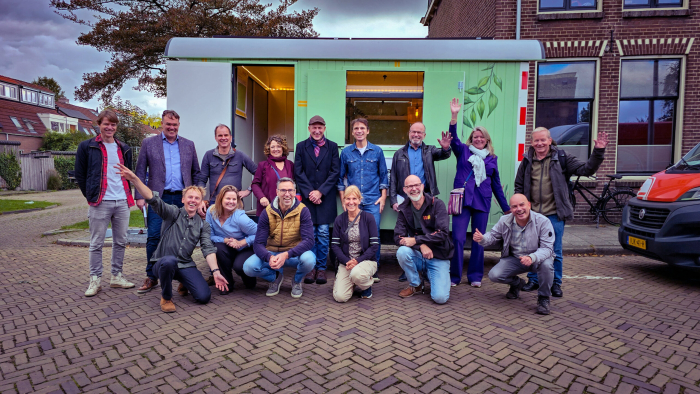
The MUSE DHC journey towards democratically owned district heating and cooling by residents has just started
There are countless reasons why we build communities. For protection, for efficiency, for emergence, for escaping loneliness, or simply because we are drawn to other people. Goethe – the German poet from the 18th century – believed that the world is empty if one thinks only of mountains, rivers, and cities; It is to know someone who thinks and feels with us, and though distant, is close to us in spirit which makes Earth an inhabited garden. It is this same logic of community building that created MUSE-DHC, the European project to democratically decarbonise district heating systems. But why exactly is it better to decarbonise district heating through a community approach?
Firstly, for protection: Producing and consuming local energy locally protects citizens from volatile and expensive fossil fuels, due to the community’s power to control the price of their renewable energy. This is now more needed than ever. Since the onset of the US-Israel war on Iran, the EU’s energy bill has increased by €47 billion. According to the European Commission, this increase is “without a single molecule of energy in addition”, meaning that we are paying much higher bills for the same energy consumption. A community approach to renewable heating and cooling can immediately solve this issue.
Secondly, for efficiency: Communities can better pool resources together. Our national budgets are under heavy pressure, and maintaining the current level of public investment, with the existing taxation, will likely be insufficient to achieve our climate goals. However, by bringing citizens, municipalities, small businesses, and technical partners together, MUSE-DHC will be able to pool our resources and transition our societies using all the currently available funds.
Thirdly, to keep the benefits local: Community-led and financed renewable energy projects generate two to eight times more return for the local economy[1], compared to installations by external commercial developers. A community approach ensures that the product of our labour does not go into the pocket of a faceless investor, but remain instead within the community that built the project.
Lastly, and most importantly, building a district heating and cooling system as a community reinvigorates our democracies and strengthens the link between neighbours.
How are we mobilising the community?
MUSE-DHC is building energy democracy through a bottom-up governance and participation approach. Each of our nine case studies started their journey to develop democratically owned district heating by directly engaging the community.
As a first step, our partners brought together local citizens, municipalities, and small businesses across Ireland, the Netherlands, Italy, Spain, and France. The objective was to inform them about the project, identify their needs, and create a shared vision for renewable energy, and in particular district heating. By giving decision-making power directly to the local community, MUSE-DHC aims to create a truly democratic transition.
Once the local communities were engaged, the second step was to formalise and professionalise the local project through the creation of a Living Lab. Each “Lab” is composed of local community members and prioritises the technical and non-technical aspects of the project. Specifically, the lab enables citizens to decide upon the type of renewable energy, the timeline of the project, and the decision-making process to ensure equality among the community members. The communities participating in the Living Labs will make decisions over their local district heating, which will be implemented by the MUSE-DHC pilots.
What do we expect?
Contrary to traditional market actors – such as big businesses – by engaging the local community, giving them decision-making powers, and creating a regular forum for discussion, MUSE-DHC is creating a truly democratic renewable energy landscape.
We expect that this process will give back control to communities over their local resources and ensure stable prices, while cementing public trust in renewable energy, and strengthening the cooperation between citizens and their municipalities.
Stay tuned!
[1] https://energie-partagee.org/ressource/etude-retombees-eco-2/ ; https://www.rescoop.eu/uploads/rescoop/downloads/RWS_Wind_CDW.pdf