
Lessons from the MUSE-DHC case study in Larmor-Plage, France
Community-led district heating and cooling (DHC) projects need more than a promising energy source and a well-engineered system. They need a business model shaped around the place, the customers and the way the network will actually operate. The Larmor-Plage case study, developed within the EU-funded MUSE-DHC project, shows why that work must evolve alongside technical design: it helps turn a low-carbon concept into a service that can be financed, operated and trusted by citizens in the long term.
Start with the service, not just the technology
With an expected lifespan of 50 years, DHC networks are long-lived public-service infrastructure. Its performance depends on the relationship between local heat demand, supply technologies, network costs, electricity and fuel prices, customer connections and operating choices. A technically feasible scheme can still face difficult decisions such as affordability, social buy-in, risk allocation, financing and the value of preserving options for future needs.
Also, a useful governance model makes these connections visible. It gives citizens, public authorities, operators, funders and customers a shared basis for decisions about their local energy infrastructure.
Meanwhile, the development of a business model translating engineering assumptions into a long-term view of costs, revenues and risks is a continuous process. It should be updated as the project moves from feasibility into design, rather than treated as a final spreadsheet produced after the key choices have already been made. Each decision has an impact on this document and will need revision.
Larmor-Plage: a local system with several moving parts
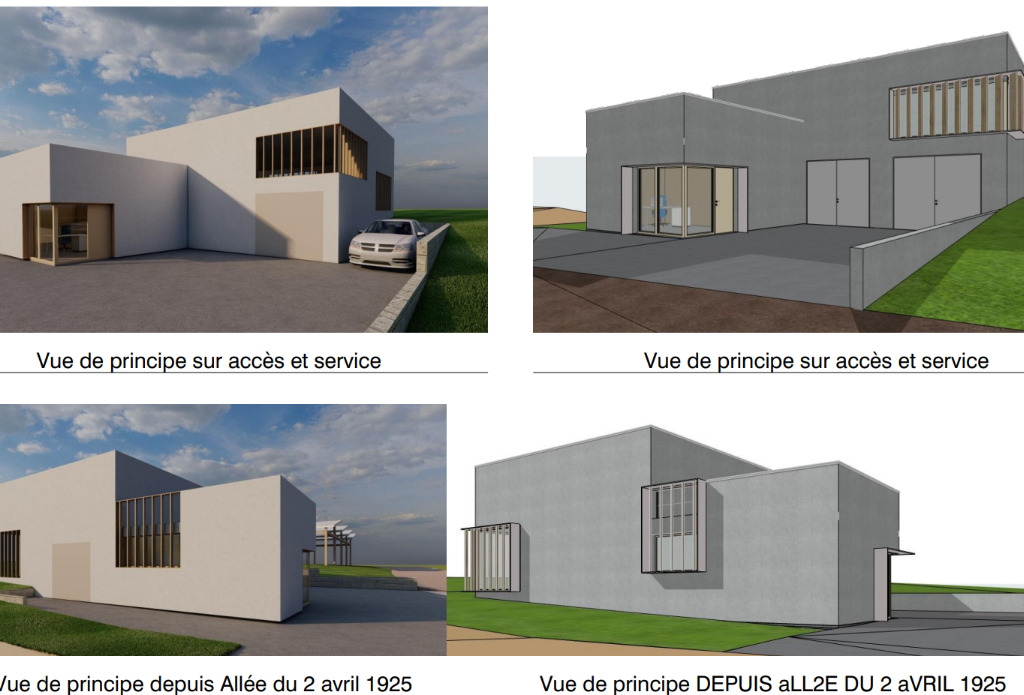
At the Kerderff district in the city of Larmor-plage, the studied network will serve a new urban project and municipal buildings, alongside existing and new collective housing, including social housing. As work is ongoing, design (ESQ) updates are recurrent, updating the annual heat and hot-water demand to about 1.35 GWh across ten buildings. The planned network is approximately 1.18 kilometers long. That mix of building types and development stages makes connection assumptions central to both system sizing and revenue planning.
Local geology also shapes this business case. The feasibility work found that vertical boreholes, rather than groundwater-based geothermal energy, were the suitable geothermal option for the site. The concept combines a shallow-borehole field with heat pumps and solar thermal collectors. In the feasibility scenario, the concept included 30 boreholes, each 190 meters deep, and 800 m² of unglased solar collectors. As the project goes on, it is then tested how operating strategy and solar recharge affect performance, cost and the long-term thermal balance of the ground.
Compare scenarios before locking in costs
The design simulations exposed a trade-off that a single headline efficiency figure would hide. Some operating strategies improved heat-pump performance but risked drawing too much heat from the ground over time. Other options reduced that pressure but changed the contribution of heat pumps, solar recharge and backup heat. The design team therefore compared alternatives, including an option with 1,360 m² of solar collectors and another retaining 800 m² while limiting heat-pump capacity. The final technical scenario remained to be selected.
These choices have material financial consequences. The preliminary design phase estimate places total project investment at about €2.52 million for the 1,360 m² option and €2.391 million for the 800 m² option. These are design-stage estimates, not final tender prices; they require further technical studies and cost refinement. The design phase also shows that the budget objective appears difficult to meet with current information. That is exactly when a business model is most useful: it can test how capital costs, energy purchases, operating strategy, customer uptake and support mechanisms affect the project’s resilience, and show which assumptions deserve attention first.
Design for customers and for change – Living Lab effect
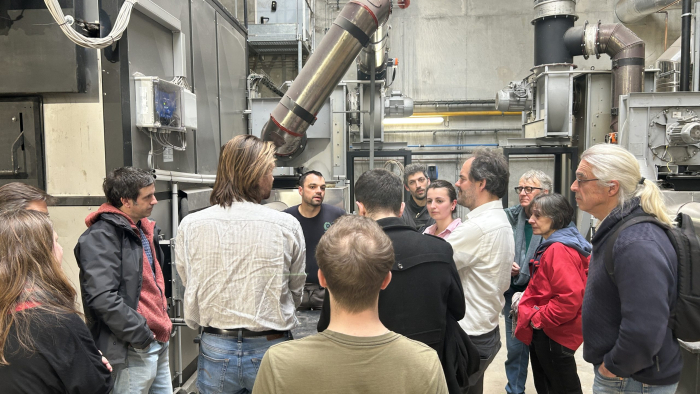
The network’s prospective customers have different profiles: schools and municipal facilities, new housing, and an elder-care facility. Their heat and hot-water needs do not peak in the same way. Choices about substation design, hot-water storage and peak-load management therefore influence equipment sizing, subscribed capacity, operating costs and the service customers receive. That is exactly when the MUSE-DHC Living Lab – local decision-making forums where citizens, municipalities, and local stakeholders decide over their energy infrastructure – come into action. Developed as part of the project, this committee allows stakeholders to take a central part within the business model decisions. Rather than imposing a predefined, top-down solution, this bottom-up approach ensures that both technical and business-model decisions are grounded in the needs, knowledge and priorities of the community, shaping the network locally. In this committee, this was where the idea of preserving the possibility of supplying cooling in the future was raised. Its recommendation is to avoid investing immediately in a cooling system before demand is established, while checking whether the buried network and plant layout can accommodate later adaptation. This indeed will have an impact on the business model in the end.
A tailored business model should connect these design decisions to a clear offer for each customer group: what the network supplies, how reliability is maintained, how prices are set and adjusted, and how responsibilities are shared. It should make the consequences of uncertainty legible, for example, if buildings connect later than planned or if future cooling demand does not emerge. Transparent scenarios help citizens and decision-makers understand both the benefits and the conditions attached to them.
From feasibility to a durable public service
The Larmor-Plage case study illustrates that a community-led DHC project does not have one fixed business model waiting to be discovered. The model is built through successive decisions: validating demand, comparing technical options, refining investment costs, planning finance and subsidies, defining operating arrangements, and agreeing how the service will work for customers. All of that being discussed in a transparent and bottom-up fashion between the relevant local stakeholders and updating this plan as things go on. Each stage should test the assumptions inherited from the previous one.
For MUSE-DHC, the lesson is practical. Tailoring a business model to local demand, resources and constraints helps project teams and the community identify risks before construction, explain trade-offs in a way stakeholders can use, and adapt the design without losing sight of affordability and long-term performance. Strong engineering makes a DHC system possible; but a strong, citizen-centred business model helps make it investable, dependable and valuable to the community it serves.
Stay tuned to know how the project will develop in the coming months!