
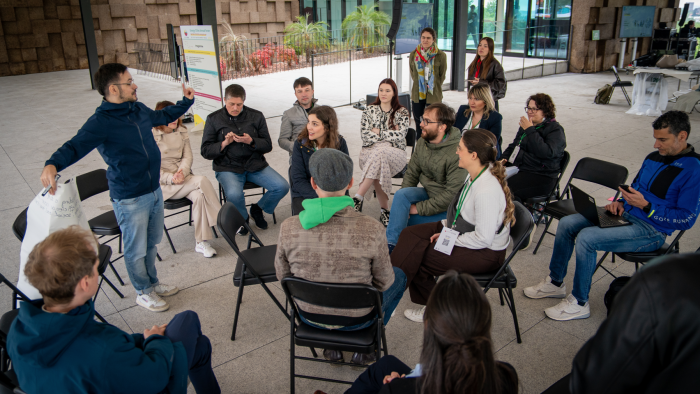
Open call for private actors
Are you an energy community, NGO, or citizen wanting to rid your community of gas or fossil heating?
Join our workshops and learn how other energy communities are achieving this!
MUSE-DHC offers 4 coachings covering everything you need to know to start developing a local community-led district heating and cooling (DHC) project based on democratic values beyond profit maximisation.
Apply for this call by 17 December to learn how to develop your own network!
Community-led Heating and Cooling, why?
Energy communities can be an effective means of re-structuring our energy systems. They empower citizens to take ownership of their local heat transition, and directly benefit from better energy efficiency, lower bills, reduced energy poverty, and more local green job opportunities. This is particularly important for district heating, as it is a natural monopoly, and can either extract or provide wealth to the community.
The advantages of an energy community approach include:
-
- No profit maximisation: Energy communities prioritise social and environmental benefits over maximising profits. Their revenues are often re-invested into the local community.
-
- Democratic Ownership: Community-led district heating is directly owned by citizens, oftentimes in collaboration with municipalities and small local businesses. This means that you decide what happens to it.
-
- Local value & Transparency: Community-led projects are directly accountable to their citizens, which means that they need to be transparent. Furthermore, energy communities are local by nature, so they keep the benefits of the transition at the local level. They can decide to invest in new infrastructure, decrease the heating bills of their members, or re-invest the revenues in local activities.
WHO CAN PARTICIPATE?
Any non-public entity wishing to develop a Community-led District Heating network. This includes energy communities, cooperatives, citizens, NGOs, small businesses, etc…
We aim to create a community of at least 20 regular participants, so please note that we expect the registrants to attend all 4 workshops.
TOPICS AND TIMELINES
The peer-to-peer coaching will be divided into x4 online workshops, given by experts in the field. The topics will cover the basics needed to develop community-led DHC.
-
- Citizen Mobilisation (Last week of January 2027) – Convincing people is crucial, but it can also be difficul. This session will teach you how to talk to your neighbours about joining a community-led DHC.
-
- Working with Local Actors (March 2027) – We live by each other and for each other: Alone we can do so little, together we can do so much. Working with your municipality and local businesses will reinforce your business model and make your community stronger. This session will teach you how to bring local stakeholders on board.
-
- Legal structure and Governance of an Energy Community (June 2027) – The legal structure of your energy community protects you from abuse, while the governance model informs how democratic decisions are made. Both of these are key to ensure a bottom-up approach to your local energy transition. This session will bring you examples of good legal forms and decision-making models.
-
- Financial and Business Models (September 2027) – Money makes the world go round, and an energy community is no different: You will need to find a way to cover the costs of your community-led district heating network. This session will present several sources of financing, and business models that you can copy.
Don’t miss this great and free learning opportunity – register now!
FILL OUT THE FORM BY 17 DECEMBER TO APPLY!
If selected, we will contact you within the first week of January 2027.
Are you a public officer interested in learning more on DHC and how to set up a network in your city? Apply for the Community of Practice programme here!